Physical Water Conditioning Technology
Don't Fight Hard Water. Change Its Behaviour.
Most water treatment approaches try to remove the problem. PV WCS takes a different position: the minerals themselves are not the problem. The problem is what they do when they crystallise on surfaces. PV WCS is a chemical-free, salt-free physical water-conditioning technology that changes the behaviour of dissolved calcium and magnesium at the point of crystallisation — so minerals remain microscopic, non-adherent, and suspended in the flow instead of bonding to pipe walls and equipment internals.
The Problem
Scale Is a Silent Efficiency Problem
Hard water carries dissolved calcium and magnesium ions in solution. Under normal operating conditions — particularly where water is heated, evaporated, or pressurised — these ions precipitate out of solution and crystallise. When that crystallisation happens at a surface, the result is scale: a hard, dense mineral deposit that builds up layer by layer over time.
The consequences compound quietly. Scale acts as a thermal insulator inside heat exchangers and boilers, progressively degrading heat-transfer efficiency with every additional millimetre of deposit thickness. As efficiency drops, energy consumption rises to compensate — and often goes unnoticed until the impact on operating costs becomes visible.
Beyond energy, scale creates mechanical and structural problems throughout a water system. In cooling towers, pipelines, HVAC systems, and boilers, scale deposits restrict flow, create localised hot spots, promote corrosion, and accelerate mechanical stress on equipment components. The result is shortened equipment life, more frequent maintenance interventions, unplanned shutdowns, and production downtime.
The most insidious aspect of scale is its gradual nature. Efficiency losses accumulate incrementally, and visible damage often only becomes apparent after significant degradation has already occurred.
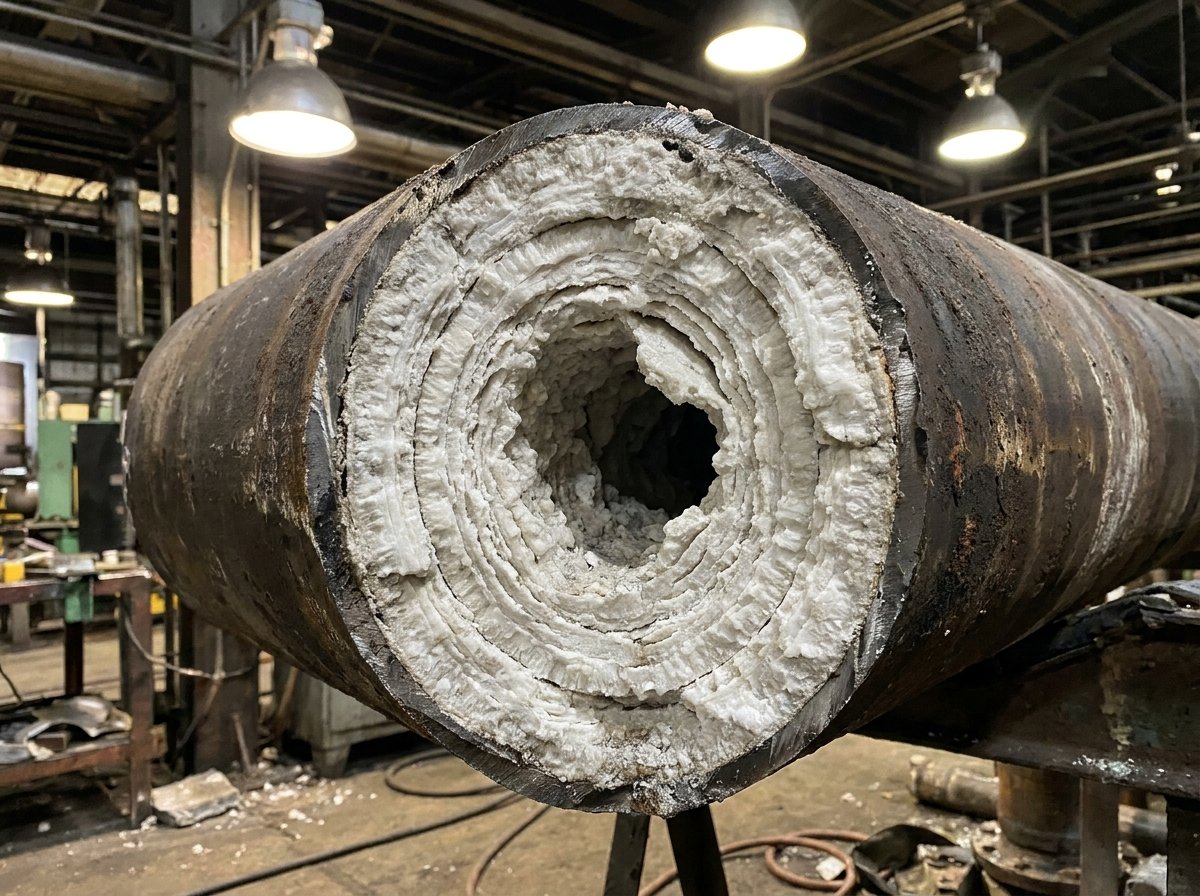
Scale deposits restricting flow in an industrial heat exchanger pipe
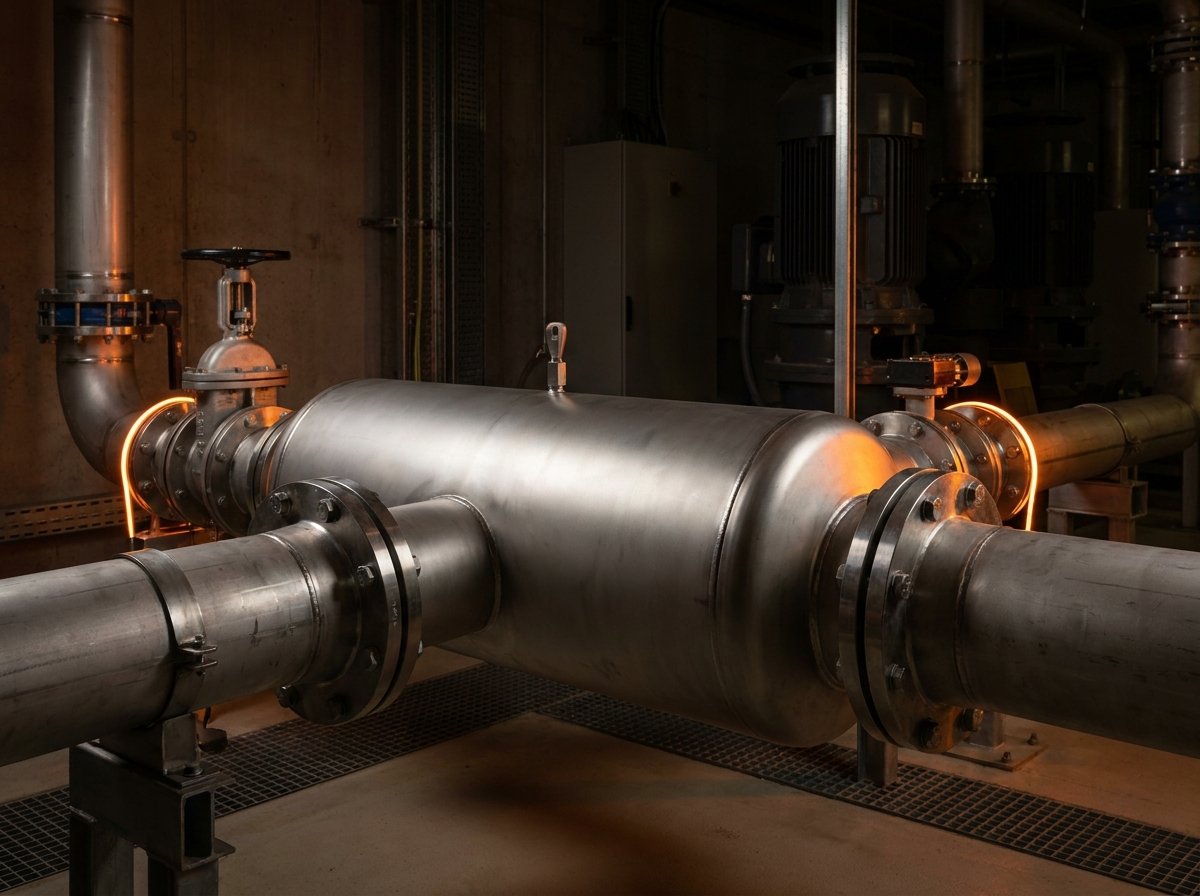
PV WCS in-line conditioning unit — inline installation on existing pipeline
The Mechanism
A Physical Approach to Water Conditioning: How PV WCS Works
PV WCS does not treat hard water by adding chemicals or removing minerals through salt-based ion exchange. It works by physically altering the conditions under which dissolved calcium and magnesium crystallise — changing the outcome of that crystallisation process at the fundamental level.
-
Water enters the PV WCS conditioning unit as part of the normal flow through the pipeline or system — no bypass, no interruption to operations.
-
Inside the unit, the physical conditioning process acts on the dissolved mineral ions. The specific physical mechanism modifies the nucleation and crystal-growth behaviour of calcium and magnesium compounds.
-
Instead of forming large, interlocking, surface-adherent crystals that create hard scale, the minerals are conditioned to precipitate as microscopic, non-adherent crystals.
-
These microscopic crystals do not bond to pipe walls, heat exchanger surfaces, boiler internals, or equipment components. They remain suspended in the water as fine particulate and are carried through the system with the flow.
-
The conditioned minerals exit the system with the water — without depositing on surfaces, without accumulating into scale, and without any chemical intervention.
Technology Comparison
PV WCS Compared: Physical Conditioning vs. Chemical Dosing vs. Salt-Based Softening
Understanding where PV WCS sits relative to conventional treatment approaches helps clarify what it does, what it does not do, and why facilities with specific operational, environmental, or maintenance priorities find it a relevant alternative.
| Dimension | PV WCS | Chemical Dosing | Salt-Based Softening |
|---|---|---|---|
| Chemical use | ✓ None — no chemicals dosed into the water at any point. | Ongoing chemical addition is the core of the treatment. Scale inhibitors, biocides, and pH adjusters must be continuously or periodically dosed. | No chemical dosing for scale, but regeneration chemicals (salt brine) are central to the ion-exchange process. |
| Salt use | ✓ Salt-free — no ion-exchange process, no brine regeneration, no salt consumable required. | Typically salt-free, though hybrid configurations may exist. | ✗ Salt is the primary consumable — procurement, storage, and handling are ongoing operational requirements. |
| Recurring consumables | ✓ Minimal to none — the conditioning unit operates without refills, recharges, or replacement media under normal operating conditions. | Continuous procurement and replenishment of chemical stock is required. Dosing levels must be monitored, adjusted, and maintained. | Salt must be procured and loaded on a recurring basis. Resin beds have a finite service life and require eventual replacement. |
| Routine maintenance | ✓ Minimal — no chemical refills, no salt top-ups, no dosing pump calibration, no resin bed management. | Dosing equipment, pumps, feed lines, and chemical storage require regular inspection, calibration, and maintenance. | Regular salt replenishment, brine tank cleaning, resin bed regeneration monitoring, and periodic resin replacement are all ongoing maintenance tasks. |
| Mineral removal | Minerals are not removed. Dissolved calcium and magnesium remain in the water but are physically conditioned to form non-adherent microscopic crystals rather than surface-bonding scale. | Minerals are not removed. Chemical inhibitors interrupt or slow the scale-formation process but do not alter the mineral content of the water. | Minerals are actively removed through ion exchange, replacing calcium and magnesium ions with sodium ions — the treated water has a different mineral composition. |
| Environmental impact | ✓ Chemical-free approach supports sustainable operations. No chemical handling risk, no storage requirements, no chemical-related safety procedures for routine operation. | Routine chemical handling, storage, and disposal introduce operational risk, require safety protocols, and carry environmental considerations depending on chemicals used and local discharge regulations. | Brine discharge from regeneration cycles is a known environmental concern in many jurisdictions and subject to discharge regulation. |
| Product warranty | 5-Year Product Warranty | Warranty terms apply to dosing equipment only. The chemical treatment programme itself carries no equivalent product-level guarantee. | Equipment warranties vary by manufacturer. The ion-exchange resin typically has a separate, shorter service-life expectation. |
Integration
Integration Into Existing Systems
PV WCS is designed to be integrated into existing pipelines and water systems rather than requiring a full system replacement or parallel treatment infrastructure. The unit installs in-line as part of the existing pipe network, working within the normal flow path of the system.
Whether a given installation is suitable depends on the specific application: the pipe configuration, flow rates, water quality parameters, the type of equipment downstream, and the nature of the scaling challenge being addressed. These factors are assessed individually — PV WCS is not a one-size-fits-all installation, and Procon Ventures conducts an application-specific assessment before recommending a configuration.
For operators managing cooling towers, heat exchangers, boilers, HVAC systems, or process water lines, the assessment process is the starting point. A technical consultation covers the application in detail, identifies whether PV WCS is the appropriate fit, and establishes what the integration would involve for that specific system.
- In-line installation within the existing pipe network — no parallel infrastructure required
- Application-specific assessment covers pipe configuration, flow rates, and water quality parameters
- Product demonstrations and technical brochure downloads available for pre-commitment review
- Expert technical support from initial enquiry through to post-installation
- Compatible with cooling towers, heat exchangers, boilers, HVAC systems, and process water lines
Start the Assessment
Find Out If PV WCS Is Right for Your System
If your facility is managing scale in cooling towers, heat exchangers, boilers, pipelines, or HVAC systems, a technical consultation with Procon Ventures starts with your specific application — not a generic product pitch. The discussion covers your current water quality, the equipment where scale is a problem, your existing treatment approach and its limitations, and whether PV WCS conditioning is technically suited to your configuration.
- Application-specific assessment
- Product demonstrations available
- Technical documentation for internal review
- Dealer and distributor partnerships
- 5-Year Product Warranty
Get in Touch
Request a Technical Consultation
Tell us about your application and current water treatment challenges. Procon Ventures will follow up to discuss whether PV WCS conditioning is suited to your specific system configuration.
- proconventures@gmail.com
- +91) 9893202509
- 1916, Scheme No. 114, Part 1, Niranjanpur Road, Indore, Madhya Pradesh, 452001, IN
- YouTube: @proconventures
- proconventurespl.com
Consultation Request
All fields help us route your enquiry to the right technical resource.